celebrating small spaces

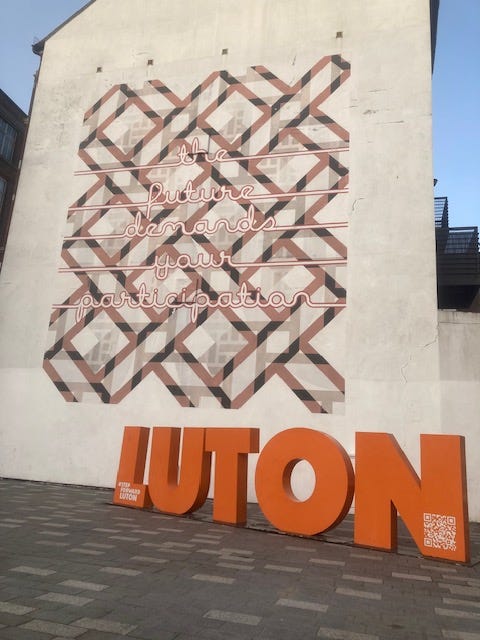
Last night I was down in Luton with my fellow pandemonialists for what turned out to be an absolutely amazing gig in Luton’s Hat Factory arts centre. We’d been invited down by Lee Nelson, who runs a superb night in the basement bar there once every three months, and it was well worth the journey. We met local artists, chatted with them about their work, learned how much we have in common, discussed the difficulties we all face in finding time to be as creative as we’d want to when so many waking hours are taken up by applying for funding (or working in the day job which covers the bills) and came away from those conversations feeling – somehow – enthused, revitalised, and more positive about the world.
And when we finally took our turns on stage in front of a warm and appreciative audience, NOFB Pitt was on fire (metaphorically) and Emma Purshouse was outstanding. With our sets out of the way, we settled down to see the wonderful Diego Brown and the Good Fairy close the night with their brilliant, witty, and ever-so-slightly bonkers songs. They’re based in the Big Smoke, and we rarely get down there, so they were (for us) a delightful discovery. Catch ‘em if you can, folks. They’re definitely worth it.
Although we were the best part of 100 miles from Wolverhampton, Lee’s night tied in with the event I’d been to in our city earlier in the week, where we celebrated fifty years of the Arena Theatre. Keeping a studio theatre running – and thriving – over five decades, in what is an increasingly difficult funding environment for artists and venues alike, is no mean feat, and theatre director Neil Reading took the opportunity to deliver a speech championing the power of small stages. (I’m sure people will already have told you this, Neil, but it was a belter – and now I’ve buttered you up, I’m going to quote from it extensively, because I believe what you said deserves repeating).
Here’s some of the closing section of the speech:
Small stages are not nostalgic relics. They’re not quaint holdovers from a pre-digital age. They’re not expendable luxuries we can cut when budgets are tight. They’re essential infrastructure for human flourishing.
When… people make the choice to be in that room, they’ll turn off their phones. They’ll sit in the dark with strangers. They’ll allow themselves to be moved, challenged, changed by proximity to something real.
And afterward, some of them will leave different than when they arrived. Not because they learned facts; though they might. Not because they were entertained; though they will be. But because they felt something true. Because they spent an hour in a room with strangers who also laughed and gasped and leaned forward at the same moments, and that shared attention created something that didn’t exist before.
Not because it reached millions, but because it reached them.
That’s the power of small stages.
Not in spite of their size, but because of it.
The small stage is where we remember: we are not metrics. We are not algorithms. We are not data points to be optimised. We are human beings. We are meaning-making animals who need to tell and hear stories in the presence of witnesses.
And sometimes; not always, not for everything; but sometimes; we need to be in a room together to remember what that means.
That’s what the Arena Theatre does so well. It’s what Lee’s night did yesterday evening. It’s what I hope for every time I get up at the mic to share my poems. It’s why and it’s how poetry and theatre quietly change lives.
Thanks to everyone who came along to the gig in Luton last night (especially the ones who were good enough to buy books), and a rare mention in dispatches to the Highways Agency for not – for once – closing every motorway on our route home. Credit where credit’s due. It was welcome and discombobulating in equal measure, gents, and I’m sure it was an administrative error which you’ll rectify next time we’re out, but thanks nevertheless.